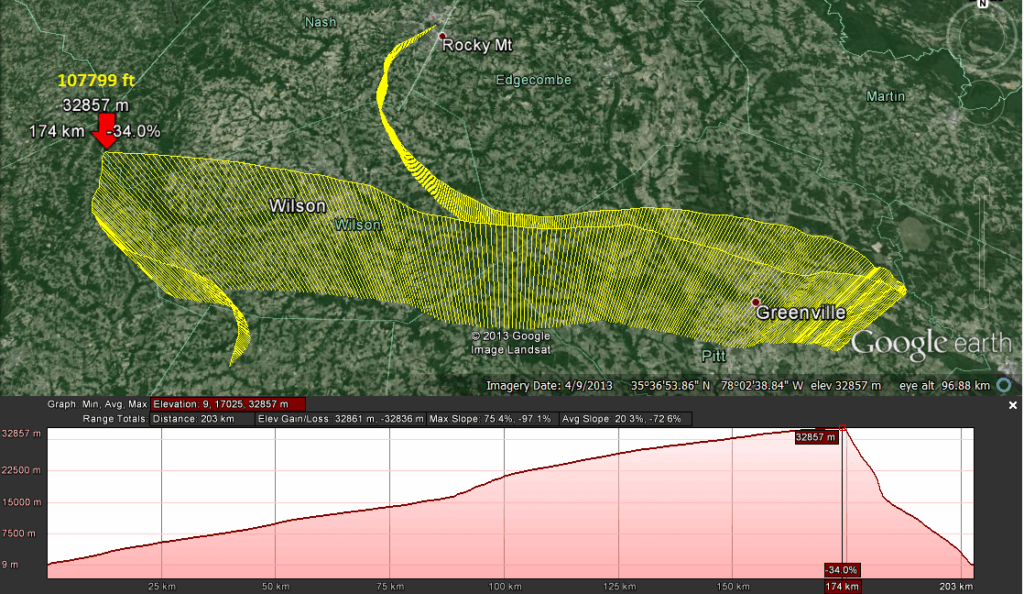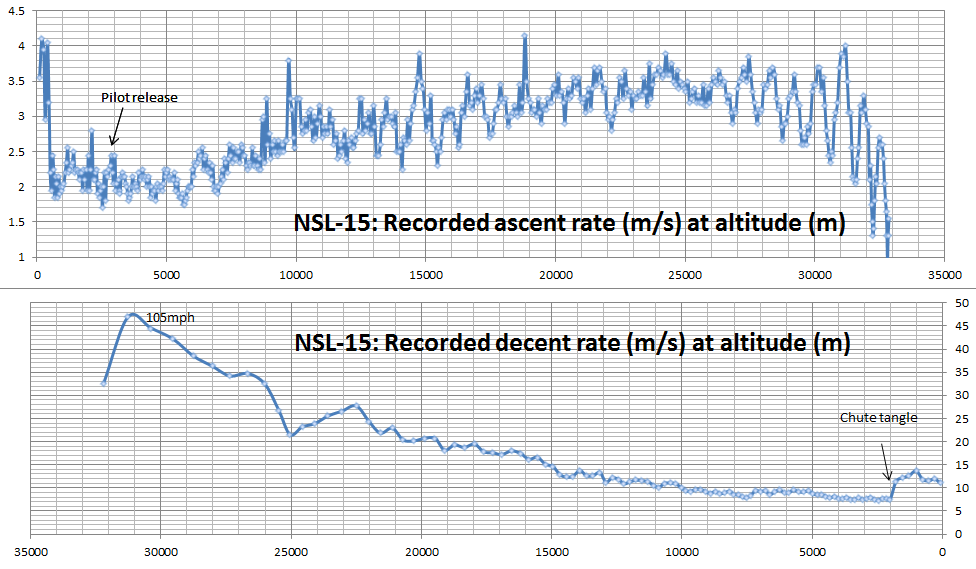
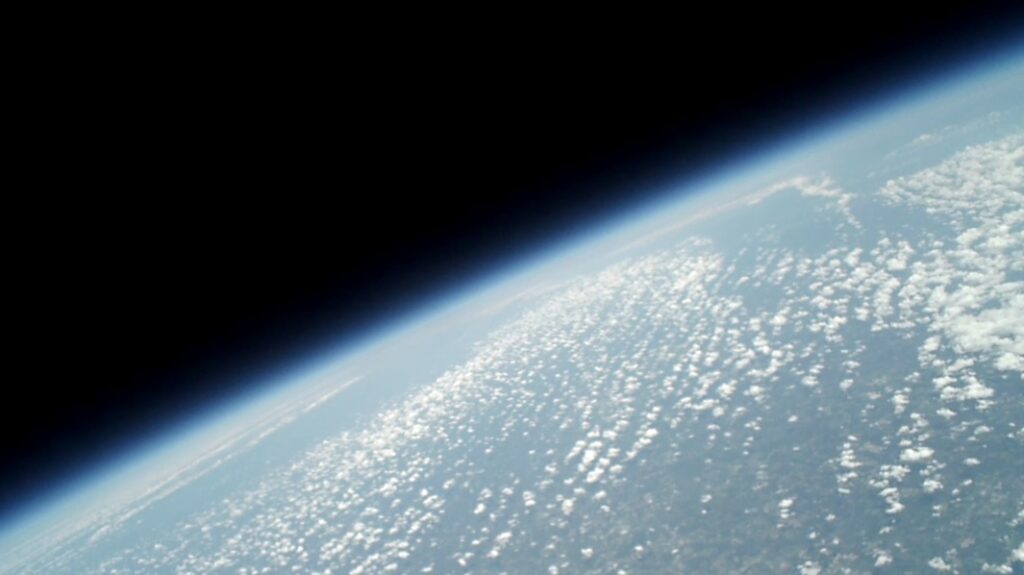
This morning we launched our third flight, dubbed NSL-15. Our launch site was the historic Rocky Mount Mills site in downtown Rocky Mount. Due to the long projected western reach of this flight, we chose to launch downeast in hopes of keeping the payload in easily recoverable terrain. The purpose of the flight was to go for max altitude. Sadly we fell short and only made it to 107,799ft. Half way into the flight, the ascent rate almost doubled and it burnt out ahead of its time — ending up south of Wilson in farm country. Nice day to drive through the countryside and the Mills made a cool launch site.
Specs/manifest:
-1500g Totex cell, 110cu ft He, total payload weight 902g included:
-BigRedBee 5W 2m APRS GPS beacon recording to flash every 20sec
-Tachyon Ops HD video camera
-deactivated Android cell phones acting as side camera with EXIF GPS data and temperature logging
-Spot tracker
-Paul’s usual homemade 36” HPR chute, radar reflector, on a 40’ bridle etc.
-36” pilot balloon
Flight stats:
0936-1336EDT exactly 4hr flight, 65.5mi track with lots of loops, Max recorded height 107,799ft (GPS data recorded every 20 sec)
Launch Team: Lucas Waslo, Tanner Lovelace, Paul Lowell, Matthew Lowell
Recovery Team: Lucas Waslo, Paul Lowell
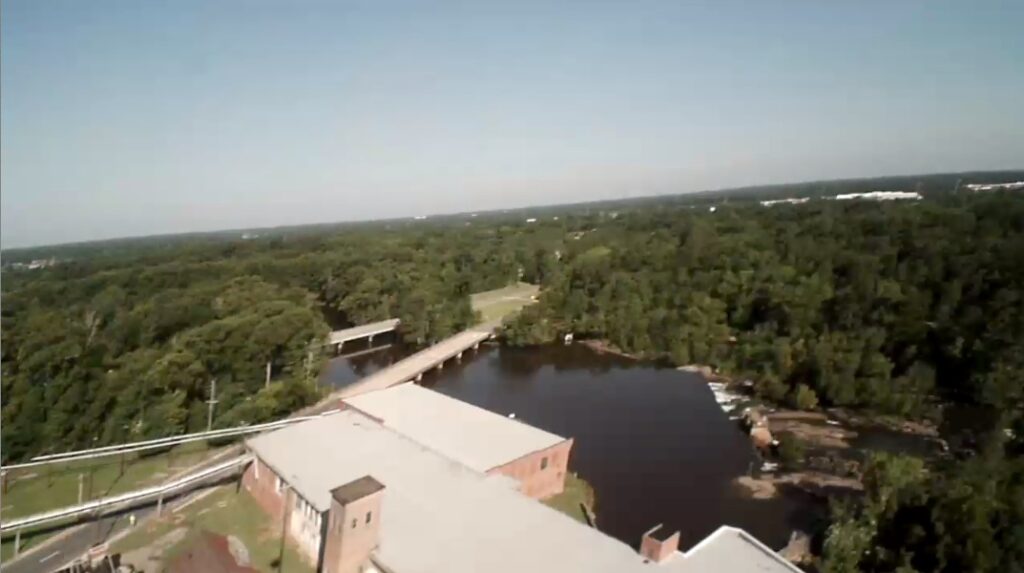
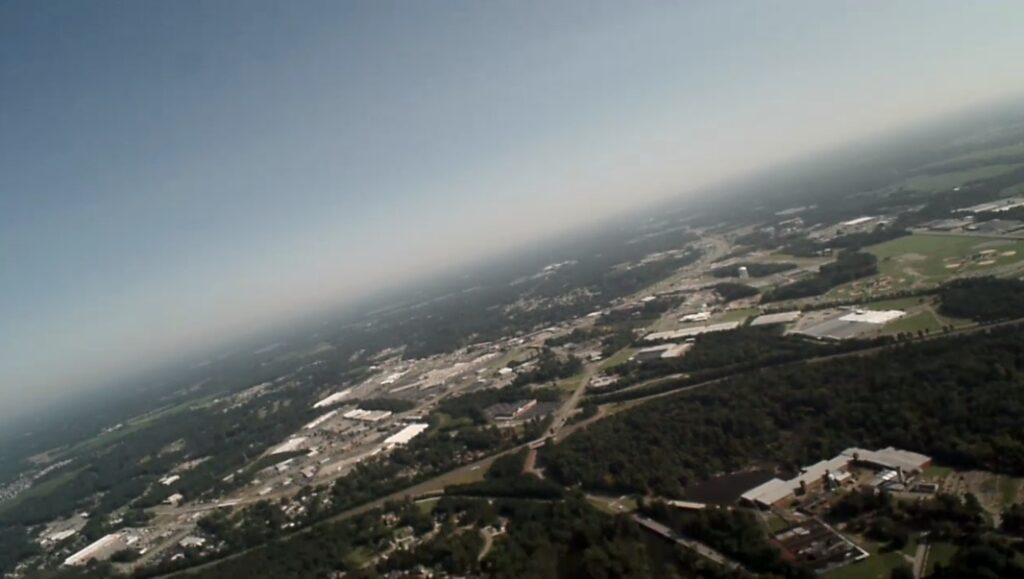
Launch at Rocky Mount Mills from the Tachyon camera. The story goes that the rocks in the river here are the actual Rocky Mounts.
Flight issues:
Paul L: So my bright idea on this launch was to use a 36” balloon attached to the payload to test several ideas:
- An easy way to measure off 14cu ft of gas. We wanted about 96 cu ft of lift gas, so taking 14 cu ft off of 110cu ft tank sounded like an easy way to accomplish this.
- Could we get additional lift at take-off that we could dump later? Adding the above 14 cu ft to the system would give lift early on. The small balloon would then burst at 30k ft and our lift would reduce, allowing for a slow approach to max altitude.
- Could adding a “tail” to our package allow it to point into the wind and not spin wildly? A swivel was added further up the bridle to allow the cell to spin and not the package.
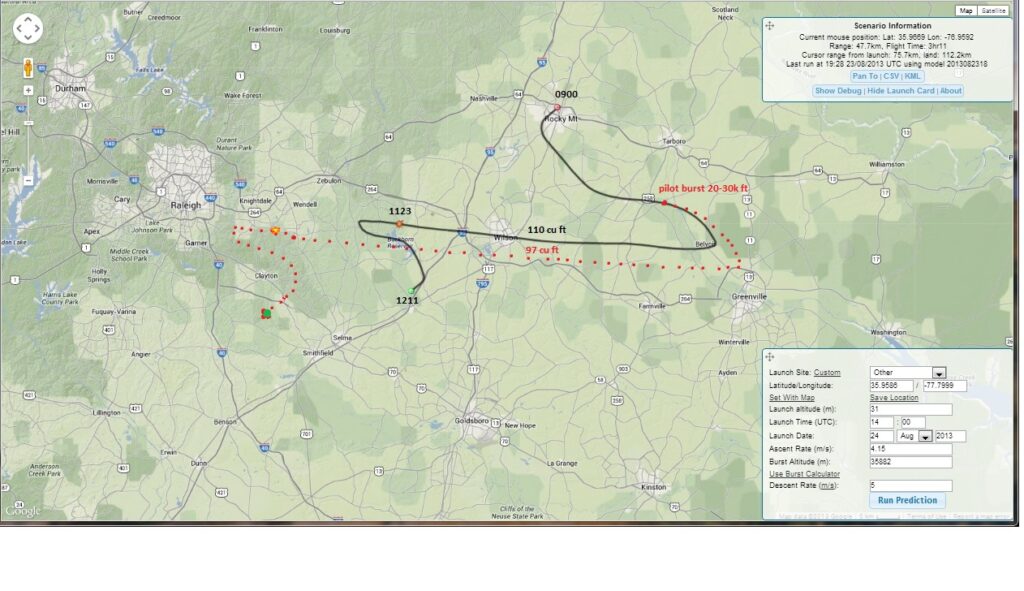
Who doesn’t like watching balloons explode on video? Let’s have two! In reality, this caused several problems:
- Our He tank was not the usual 10% overfill. It was more like 15%. Still our GPS data shows ascent rates from 2-4 m/s. Jury still out on this.
- The pilot balloon had a lower lift than the main. This caused it to act more like a parachute and actually slowed down ascent! Doah!
- I didn’t take the time to secure the pilot the way I intended. Instead it was on a 3’ line and acted like a yo-yo. As a result it was a much bumpier ride and the bridle actually got yanked out of position, resulting in a 45 degree list to the video for the rest of the voyage. Doah!
The “tail” ended up causing a pan back and forth that was worse than the usual spin. Doah!
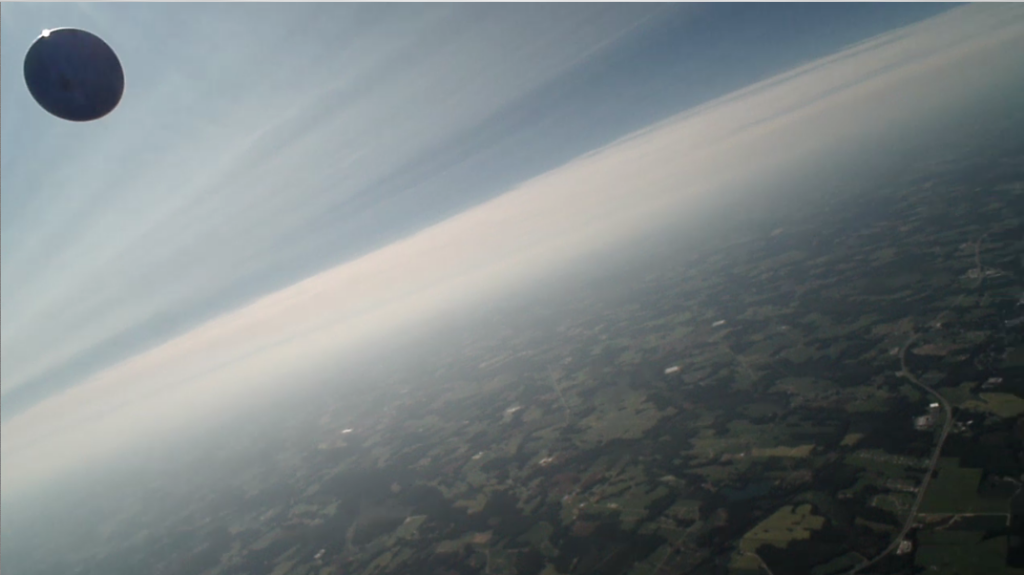
Thankfully we rid ourselves of the pilot 21min into the flight and it took off on its own (untied itself) — Got a nice video of it heading away.
Results:
Let’s not do the pilot balloon again.
We got 3hrs 21min of awesome video. It was neat hearing the sounds of trains and Harley’s thousands of feet below.
I’m scratching my head over the doubling of lift in the cold part of our flight. Is this Solar heating?