
Around-the-World #1 (ATW-1) Project Helios
David (Alex) W. has been flying weather balloons with his father Tim for years. This past November, Alex made a friendly wager with his friend, that Alex could send a balloon around the world before their upcoming high school graduation.
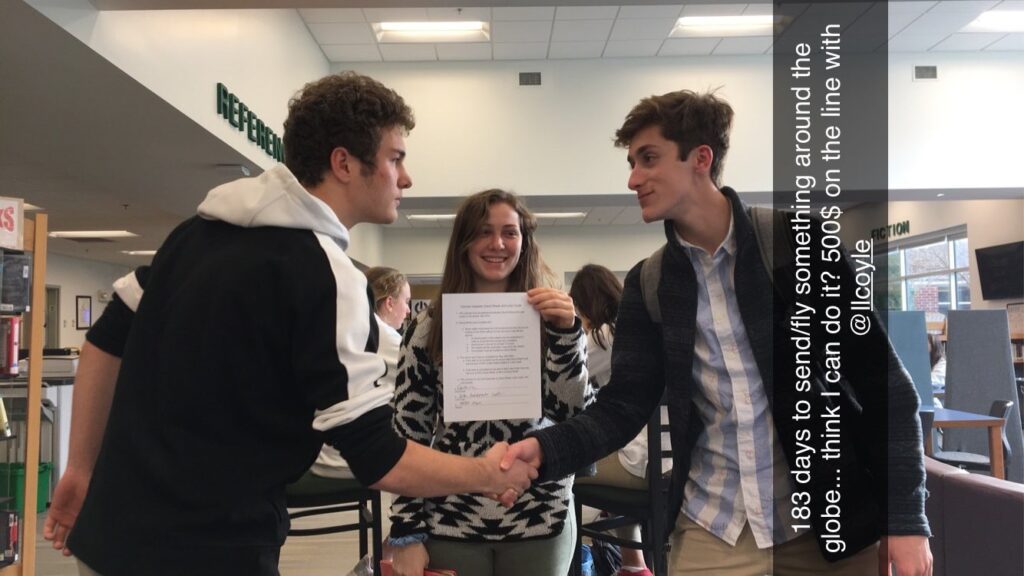

Alex code named his first attempt of his Project Helios, Around-The-World #1 (ATW-1)
NSL-78 was a brief test of this flight’s hardware, a LightAPRS-W tracker. This is a solar-powered computer, GPS, and two radio transmitters — frequency adjusting 2m APRS, and long-range 20m WSPR.

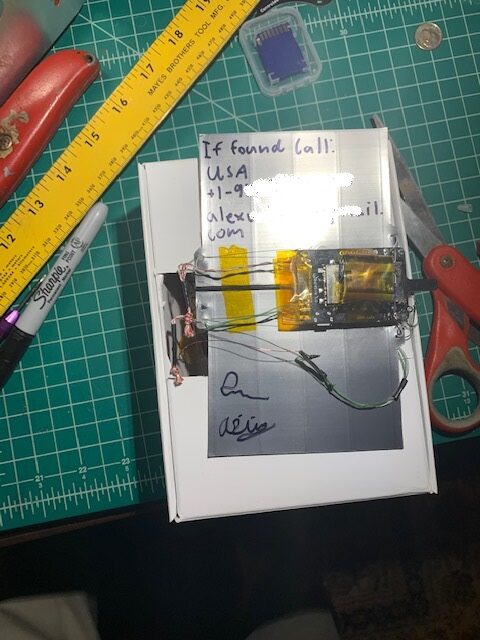
Tracker mounted to back side of solar panel


After NSL-78, the hardware was rebuilt and attached to a specially constructed, superpressure “pico” balloon. A small amount of H2 was added to achieve just a few grams of free lift. The system was launched from Cardinal Gibbons High School on the afternoon of January 29, 2020.
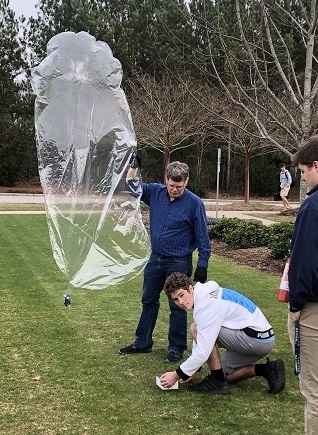
Alex prepping for launch from Cardinal Gibbons High School

Powered exclusively by horizontally mounted solar panels, this balloon would only transmit from mid-morning to mid-afternoon. A super capacitor buffered the power load for the LightAPRS-W board which would wake-up, gather GPS data, and then transmit tracking data on a specific schedule. At specified times, the tracker would send out 20m WSPR packets. These took considerable time to transmit and only contained basic information — namely transmitted power and a 4-character Maidenhead Grid Square coordinate. This gave the flight’s location within 1° latitude by 2° longitude (70 mile x 100 mile rectangle).
In between WSPR packets, the transmitter would also send APRS packets. APRS telemetry provided exact location, altitude, solar voltage, board temperature, speed, heading, and GPS coverage. Different countries use different APRS frequencies in the 2m band, and a few countries prohibit it entirely. The computer had to figure out, from its GPS location, what APRS frequency to use, if any.
From January 29th through February 8th, we tracked the payload daily as it made its way successfully around the world!
Flight notes
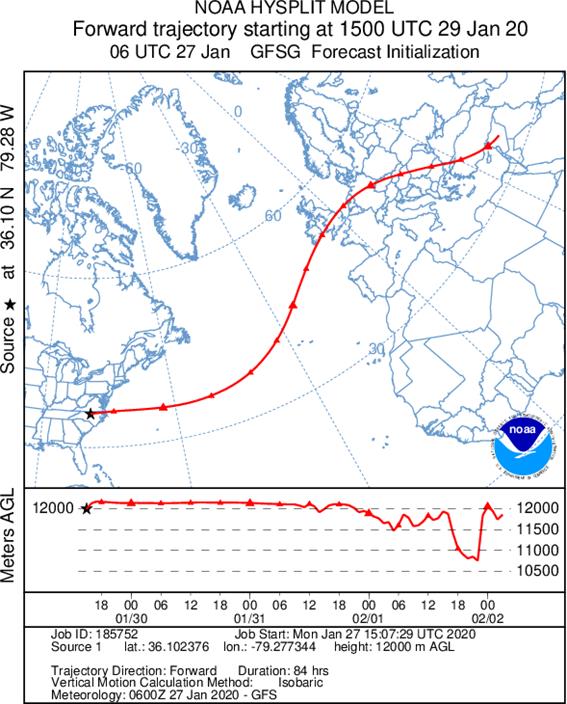
Day 1 Initial flight projection

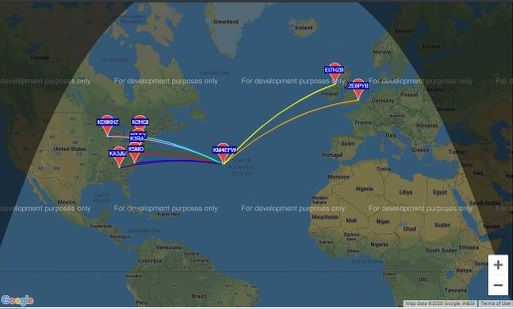
Day 2 over the Atlantic via WSPR

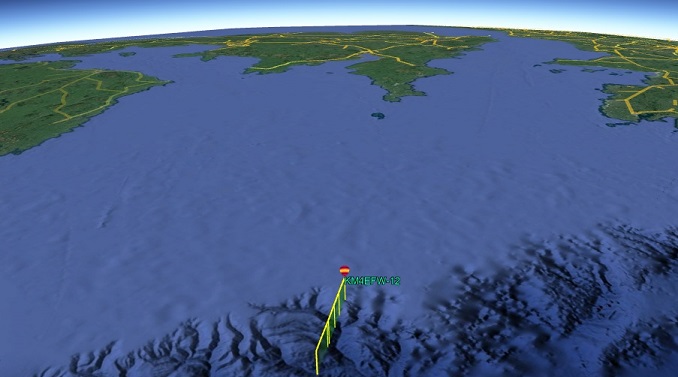
Day 3 APRS data shows nearing Ireland

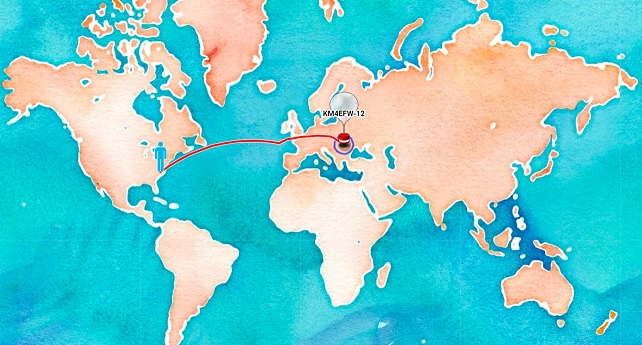
Day 4 Over Hungary and Romainia

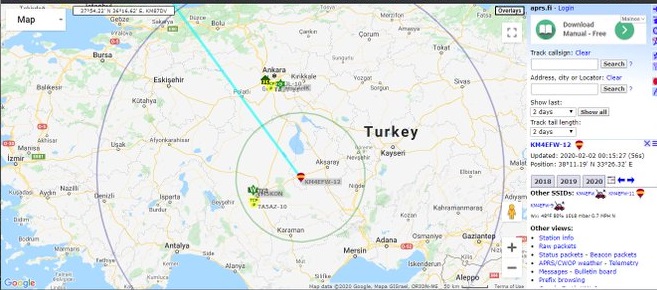

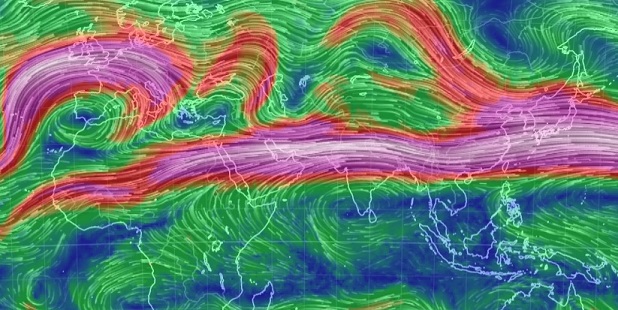
Note the strong winds across Middle East and China

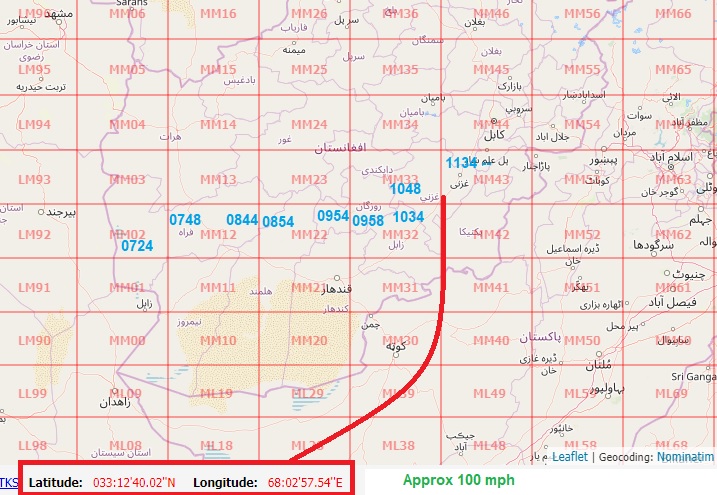
Day 6 Plotting WSPR locations over Afghanistan

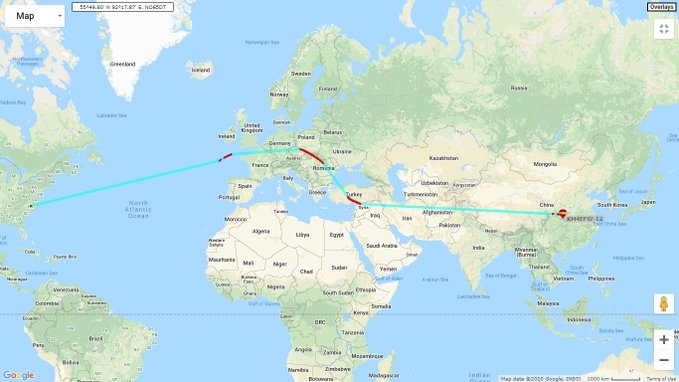

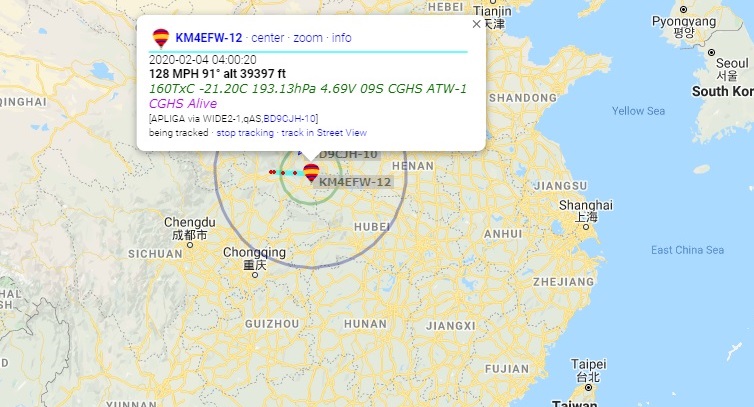
APRS telemetry still looking good

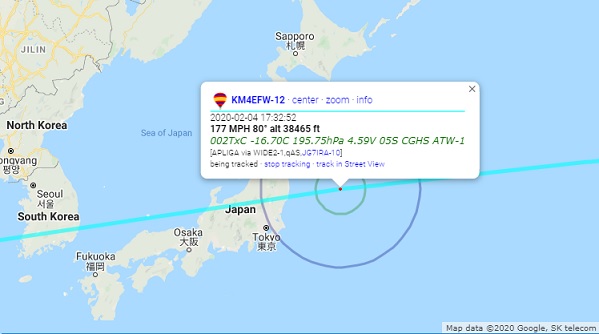
Day 8 Morning wake-up off the coast of Japan

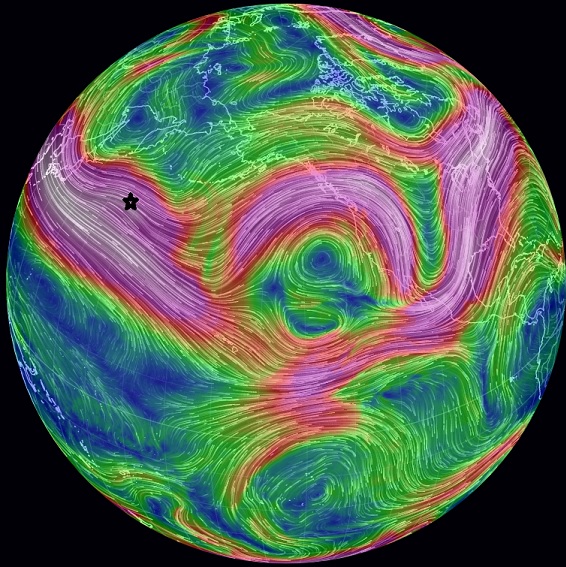
Day 9 Pacific between Hawaii and Dutch Harbor

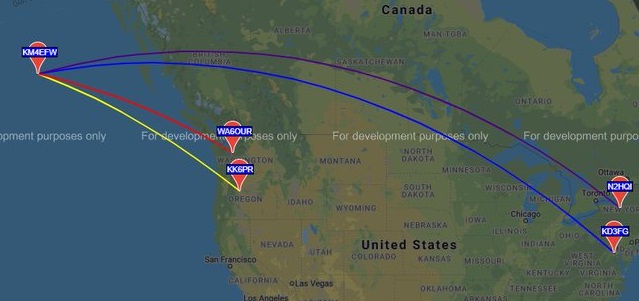
Day 10 Approaching North America

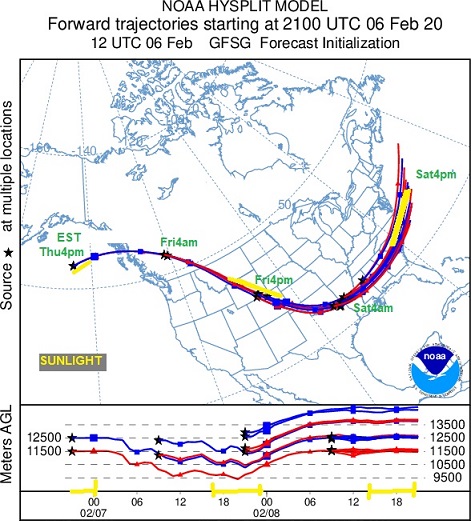
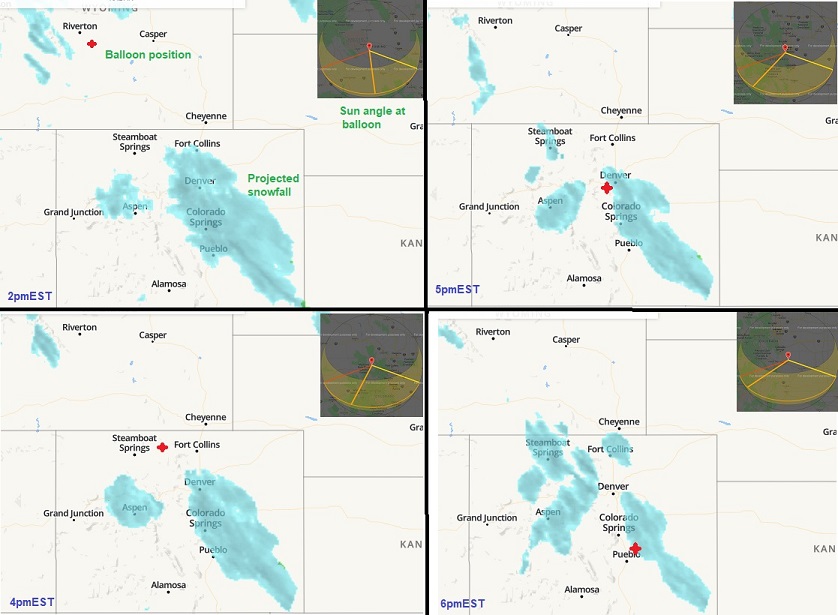
Prediction for the following three days

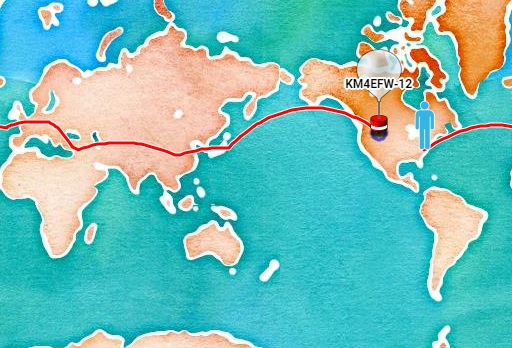


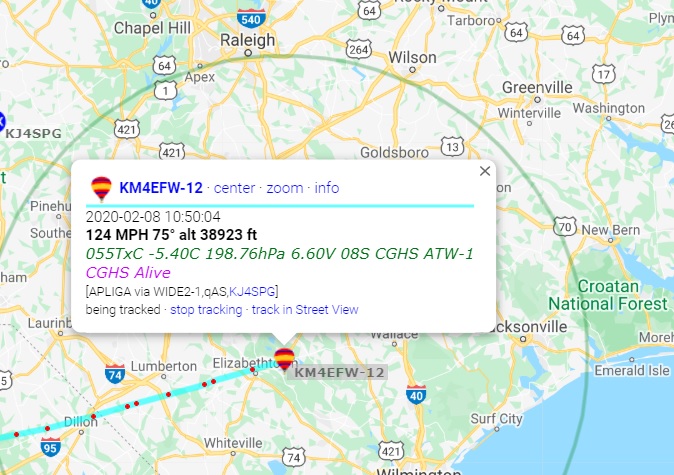
Day 12 Completed first trip around the world !

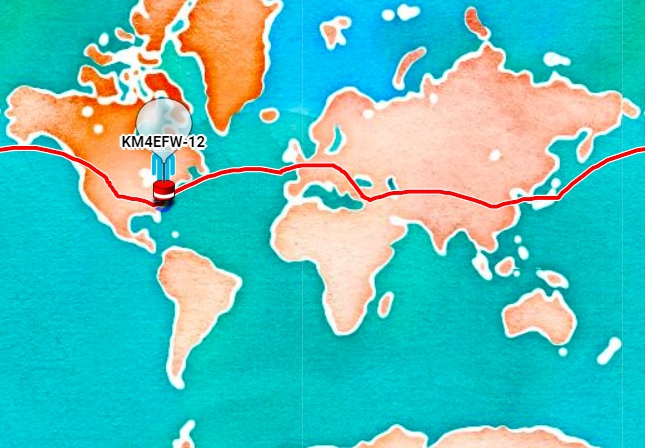
12 Feb, 2020: Flight has since continued on to England and then down to Morocco and over to Egypt.
17 Feb, 2020: Flight has come ashore in North America again. Currently floating over Mexico
29 Feb, 2020: Flight completed third full trip around the world.
11 Mar, 2020: Flight completed fourth trip around the world.
29 Mar, 2020: Flight completed fifth trip around the world.
10 Apr, 2020: It’s been 10 days since last confirmed contact.
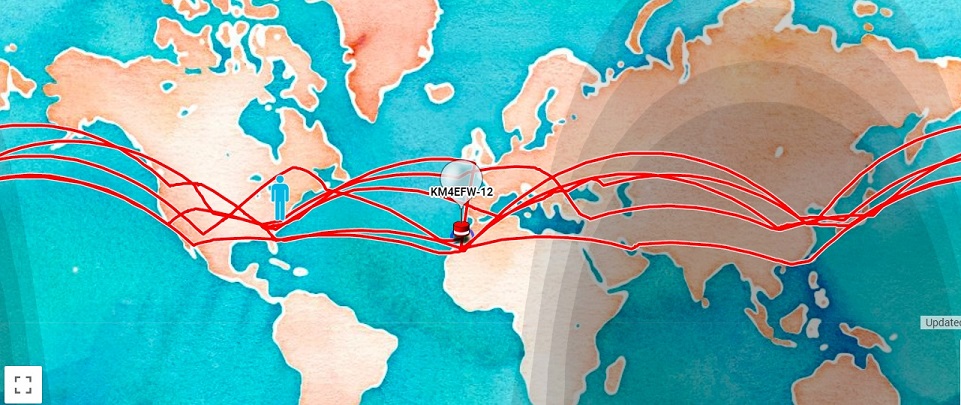
The last APRS packet was received as the balloon past the Canary Islands approaching the coast of Morocco midday on 31 Mar.2020-03-31 11:27:14 Position: 30°11.70' N 10°24.24' W
WSPR packets continued until sunset as it made landfall and flew over Marrakesh, Morocco. No further APRS packets have been received at this time. Assuming flight consistent with the previous trips, the balloon should have followed its usual patch across the Mid-east, China, and over the Pacific.
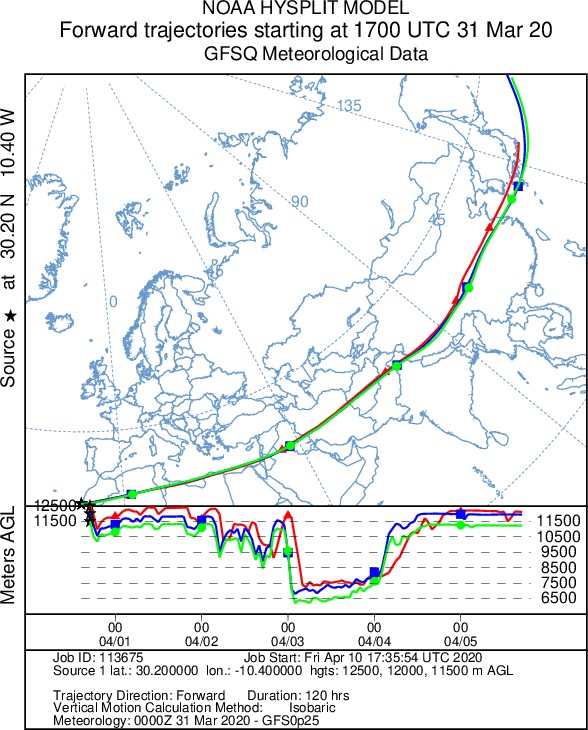
But a few days later, a single WSPR packet was received in an unusual location!2020-04-03 14:50 Grid square: QP58
This location is in northern Siberia (roughly 68.5N, 151.0E). Which seams way off of the expected path. Only a single packet was received. Was there some sort of GPS or data corruption that led to this strange packet? Or did the balloon really drift towards the north pole?
If the balloon did travel far north, then it makes sense that we haven’t heard from it. The sun angle would be too low in the sky illuminate the solar panels sufficiently.
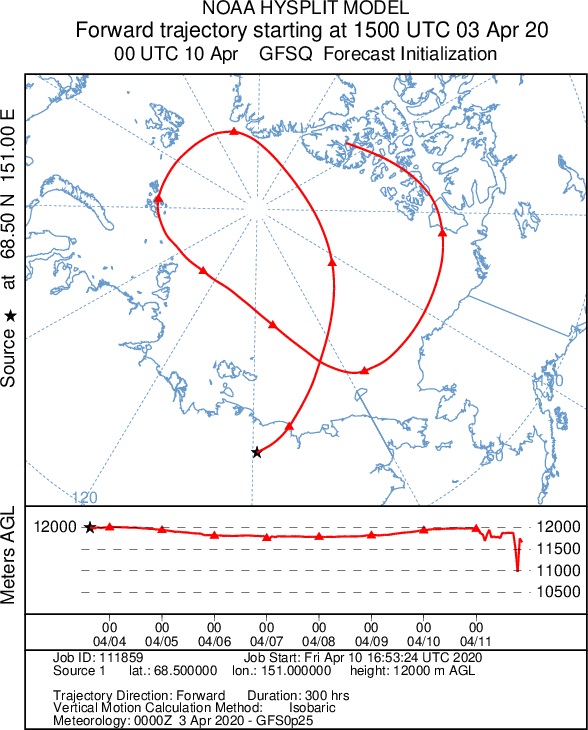
If this did somehow happen, the projected flight path would keep the balloon far north for quite some time to come. We will never hear from it again.
Design notes from Tim
- Payload
- APRSLight-W transmitter
- 100mA Solar cell: MPT4.8-150
- 2 5F 3V Supercaps:. BCAP0005 P300 X11
- 2m antenna: 0.010″ guitar wire with 32 awg multi stran-plus fishing line for stain relief
- 20m dipole antenna: 32 awg bell wire with 32 awg multi stran-plus fishing line for stain relief
- 10 lb sprecta line
- Total weight 23.55 grams
- Balloon: SBS-13
- Target free lift 8 grams / 1m/s ascent (ended with 9.95 grams of lift because of a verbal communications error between the fill team and payload team at time of fill)
- Target flight alt, 42k ft / 12.5km
- Lifting gas ~3cu ft H2
- The TX was mounted below the solar cell with 3mm closed cell foam pad samwitched in between. All attached with Guerrilla Glue.
- The (+) side of the cell was on the GPS antenna side
- Four mounting points were used to secure the TX to sting creating a four point sling up about 20cm to a single point then one line to the balloon.
- Two Power and ground wires were used for redundancy.
- A small carbon rod was glued to the back of the solar panel to keep panel rigid.
- Twisted pair ran from the TX to the edge of the panel then the antennas started.
- TX was conformal coated with a re-workable silicone spray. 3 layers
- Panel was trimmed to reduce weight.
- The panel was sprayed with two coats of clear acrylic UV resistant spray.
- All tie in points and solder joints were reinforced with a median body CA
- Antenna mount points to TX were further stain relieved with two layers of Kapton tape.
- S-caps were soldered in series and to the TX power input. Then Glued with CA to the 2m TX.
This all may be overkill but we did a test flight (NSL-78) with designs shown elsewhere and at 12km while the balloon was entering the jet-stream the panels and the antennas got ripped off. It was a worst-case scenario in that we had an ascent rate of 6+m/s. We had a backup TX that allowed us to recover the payload. There was nothing left but the LightARPS-W on a string.
Fill info:
- $500 0.001gr scale from the high school. It was touchy and took 20 minutes to warm up.
- A toilet paper core cut in half was used to manage the long antennas during transport.
- Had a police officer standing by with a fire extinguisher. First time filling H2 inside.
- Air temp at fill was 21C while launch temp was about 10-12C.
- HVAC was shut down in the classroom.
- To minimize H2 risk, we filled a 20lb new propane tank with 3cu of H2 from a 200Cu ft cylinder. We only had the small 3Cu ft propane tank in the building. This was overkill and not necessary.
- Tarred scale to 0.0 with a 40-gram paperclip then connected the clip to the balloon.
- Fill was done with a 5mm ID vinyl hose and pressure was controlled from tank valve.
- Sealing was done with a Hanger 9 iron. We did have some trouble with getting the correct temp and acceptable seal.
- Balloon was connected to payload by a double larks-head knot. Then balloon stem was folded over and wrapped with 3 layers of 10mm wide Kapton tape.
- All loop knots were double overhand with CA.
- Less than 1km/hr wind at launch time. Was perfect.
Three things currently concern me.
- The added lift and heavy weight of the payload may put too much strain on the balloon.
- The payload is experiencing a 60+C delta every day. That will play hell on everything.
- The S-cap is only rated at 6V at 85C. I knew this going into the design but figured the low temperature may help expand the upper voltage limit. We chose a 100mA cell vs a 50mA because I was concerned about the low sun angle. The panel does droop slightly. I figured that may help also. We will see how the cap holds up. Today the voltage tailed off rather quickly. I did not like that.